When we first began homeschooling, we purchased a reading curriculum. The curriculum featured a reading passage and then pages and pages of workbook exercises to evaluate the comprehension of what was read. This worked okay with my oldest child, who loved to write, but the next students were bored to tears by this work.
Around this time, I discovered the works of Charlotte Mason. Especially The Charlotte Mason Companion, by Karen Andreola. This book helped me to see that reading comprehension could be checked by having the child tell back in their own words what was read. This became a favorite method for checking reading comprehension as well as a wonderful way of working on speaking and listening skills.
In this short video, my daughter and I demonstrate a few examples of how we do narration.
If you would like to know more about narration, check out this post from Simply Charlotte Mason.
My son and I are enjoying this project of making videos about homeschooling, but we would love some feedback. If you have any suggestions for how we could improve, or have a question that you would love answered in a video, would you leave a comment below?
Thanks for reading and watching!
https://youtu.be/QKsRnC0FciE
Showing posts with label Charlotte Mason. Show all posts
9/11/15
8/10/15
2015 Curriculum Plan
As we soak every moment out of summer, I am simultaneously planning and purchasing for our upcoming school year. This year I will officially have five students, although my oldest student is only in my school this year, because I discovered through trial and error that trying to get scholarship funds to a Christian college is much easier if you are applying as a freshman than as a transfer student. For this reason, my oldest son will do one more year of high school to better prepare him to transfer as a freshman, and hopefully get some financial help with his schooling. I will update next year, with the results of this experiment


I will also be sending my other high school student to community college with the oldest three. This is another experiment. Only time will tell if it is a good one. He took an online class at the community college last year and scored well, so I feel it is worth a try to let him take two days a week of classes with his older siblings. Although I am presently not willing to send my children to public school (aside from my spiritual objections, I feel that high school wastes a lot of time) I do believe that older boys especially might benefit from the instruction of someone other than their mother as they grow. Especially this mother. I love teaching the younger years, but because I tend towards being a little better at relationships than consequences, having the experience of a classroom with a teacher who doesn't love them, might benefit my kids as they grow. So far, it has worked well for my students, and we will see how this one does.
Without further explanations, here is the plan.

1st Grade Boy
Spell To Write and Read/All About Spelling
Explode The Code Book 2
Rod and Staff Reading, Grade One, readers only
Mystery of History, Ancient Times
Apologia Flying Creatures
4th Grade Girl
Bible Copywork
Spell To Write and Read
Memoria Cursive
Ancient History Reading List
Mystery Of History Ancient History
Apologia Flying Creatures
8th Grade Boy
Life of Fred Algebra
Bible Copywork
Jr Analytical Grammar
(I will do this as a class with the younger sister,
followed by Jr. Analytical Grammar Mechanics or R&S Grammar)
Theme Essays with Co-op
I.E.W. Ancient History Writing Lessons
Ancient History Reading List
Apologia General Science
Studies in World History-Stobaugh
10th Grade Boy
Algebra-Community College
Theme Analysis with Co-op
Ancient History Reading List
Beginning Painting-Community College
Philosophy 1 (audit Community College class with older siblings)
English 1A (semester 2)
Studies in World History-Stobaugh
Spanish 2-BJU
12th Grade Boy
Study hard for SAT
Chemistry- Community College
Geometry- Community College
U.S. History
The children also do martial arts and ballet for physical education, as well as music lessons, for, well, music.
For science and history, we will focus more on notebook pages with illustrated and written narration than on using tests or worksheets to assess their progress. We will do experiments and hands on work in our co-op.
For Bible, I am using Long Story Short and The 18 Inch Journey as my curriculum. We will also be reading through the Old Testament and copying Bible verses.
This post has affiliate links.
6/7/15
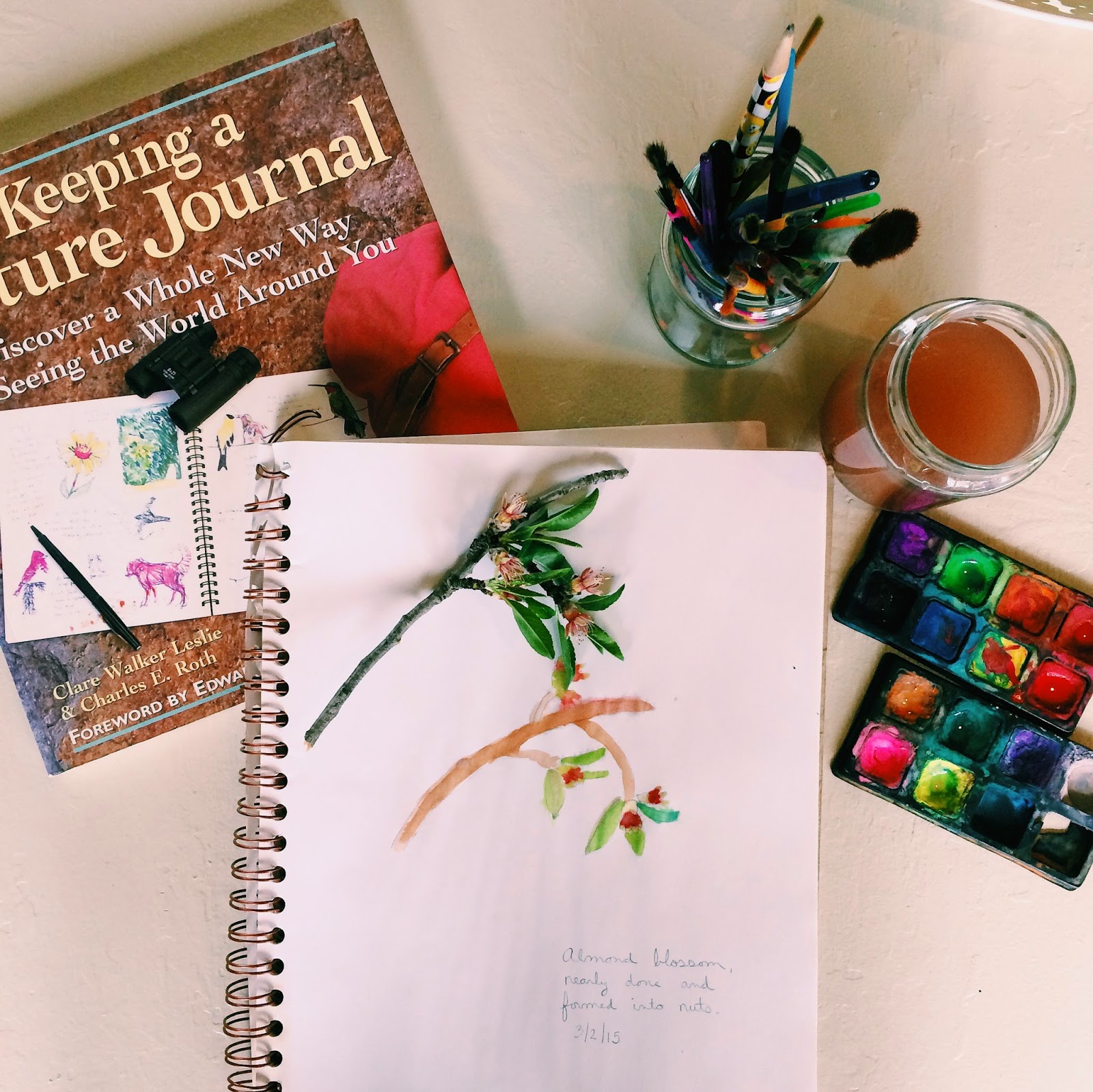
Nature Journaling
The first resource that has helped us in our nature journaling efforts is the amazing artwork of Kristin Rogers which is featured in the bundles from the Wild and Free homeschool community. Kristin is a photographer and artist from Southern California who is an avid nature journaler and homeschooler. Her artwork has inspired more nature journaling in my homeschool, but it has also inspired me to take the time to nature journal. My artwork is pretty basic, and I often want to pass it off as that of one of my youngest children, but I have so enjoyed sitting with my children and visiting together over paints and paper, instead of just giving them nature journaling as an assignment while I go on with other tasks.
The other resource that has made nature journaling more fun in our homeschool is the beautiful resource from Simply Charlotte Mason, "Journaling A Year In Nature". This is an amazing resource which has given us some great prompts to guide our nature study. The journal is spiral bound card stock, organized by season. The hard cover and spiral binding make it very convenient for travel, and the heavyweight paper holds up well to watercolor painting. The journal is organized by season and has pages specific to different kinds of natural wonders.
My son and I drew crabs in the section on animals and insects, and my daughter and I painted tall trees in the section on trees. The journal also includes inspiring quotes to give you "something to think about" while you are journaling. We took the journal on our recent ten day family camping trip and filled it with drawings and paintings of the natural treasures that we found.
We saw so much natural beauty on this trip; soaring trees and wafting ferns, tiny crabs hidden under rocks, and beautiful rushing waterfalls. I took lots of pictures, but we also enjoyed sitting quietly in the trailer after a day of exploration and recording our finds in our Simply Charlotte Mason Nature Journal.
We have incorporated drawing and painting into every subject of our homeschool. We do written and illustrated narration in place of book reports, draw and paint narration for history subjects, and paint our way through science studies. Resources that help us become more proficient at recording what we are learning, such as "Journaling A Year In Nature" are a welcome addition to our homeschool.
If you are looking for some supplies to go along with your nature journaling, these have been recommended by artists that we follow.

This post contains affiliate links.
3/3/15
Westward Expansion
We have been having such an interesting year, studying
Early American History. It is hard to believe that we are in the last three months of the school year already! It is flying by. I often wonder if I am doing enough schoolwork, but seeing my children excited about what they are learning, reassures me that we are on the right track.
We recently got together with friends to celebrate our studies of the pioneers and westward expansion. These get togethers are one of the highlights of our history studies. While at home, I read lots of great books to the children, we do map work, and also journaling, but the monthly co-op meetings are when we can delve into hands on projects that require more preparation.

At this months get together we made butter! This was actually incredibly easy and group friendly. We simply poured cream into clean mason jars, screwed the lids on tight and let the kids go crazy shaking them until a nice lump of butter had formed. I took a picture of our butter after we made it, but then when I was going back through the photos, I couldn't figure out what it was and deleted. It was yummy, if not photogenic.
The butter was spread on fresh baked bread, the best of pioneer treats, and eaten along with tortillas, and cattail tubers which we had harvested from our pond. A good study of the pioneers and westward expansion wouldn't be complete without talking about some of the foraged foods that they ate to survive.
We also drank tea made from nettles. Not the tastiest of drinks, but super healthy and according to research, a good traditional remedy for all manner of illnesses, including allergies and anemia.

Another thing we do at our co-op meetings are oral presentations. I feel that being able to give a report is an important part of homeschooling. It is also a helpful motivator for my children to do well on their journaling projects so that they have something good to share with the group. We have been alternating Draw Write Now books with fine art postcards from Mommy It's A Renoir for art journaling prompts. These go nicely with narration exercises, and if we are not feeling creative enough to come up with an original narration, we simply copy the sentences from Draw Write Now as well. These journaling pages then become oral reports for the younger students.
Draw Write Now, Book 5: The United States, from Sea to Sea, Moving Forward (Draw-Write-Now)
The oldest of my four students still in my homeschool prepared a report on health care, or the lack thereof, during the time period we were studying. My 12 year old created a stop motion Lego movie about Civil War Sea Battles. I love seeing them use various technologies and mediums to prepare their presentations.

For map work, we looked at where the Lewis and Clark Expedition traveled, as well as what area the Louisiana Purchase encompassed. Later, we traced U.S. maps and labeled them with the route which the Lewis and Clark Expedition took, so many years ago.

Back at home, I read to the children from "Sacajawea" by Della Rowland, while they made a tent and pretend fire which they roasted pretend marshmallows over. Or maybe it was bear meat on a stick?
Stories are great at providing prompts for imaginative play. They also do so much to expand your children's vocabulary, these are a few of many reasons why we make a high priority of reading aloud. I also have a basket of books based on the period we are studying, which my children are encouraged to read from as we work our way through the year. If possible, I give my older children books which include source documents. I want them to be aware of what the thought process of historical figures was, and not just hear their stories through a modernist filter.
The Story of Sacajawea: Guide to Lewis and Clark (Dell Yearling Biography)
Little House Nine-Book Box Set
American History is full of fascinating people, and I am studying it again, with some of the most fascinating people that I know. I hope that your children, and your studies, bring much joy and inspiration to your life as well.
This post contains affiliate links (Amazon)
9/15/14
Discovering Early Americans
We have started another wonderful year of learning and this year we are doing Early American History. We have used various curriculum in the past but this year we are staying on a budget with homeschool materials and just studying a different event in American History each month without purchasing a curriculum. We will then celebrate with a monthly project day with a few of our friends.
Although we don't have a formal curriculum this year, I own a few high school textbooks and student readers which I can use as resources for the younger children, as well as a wonderful set of timeline figures and blank maps which will be resources that I pull from.
Our first month was the study of Native Americans, and we found some interesting books to read about a few different tribes. Because the content of some of these books may be a bit dark, I will edit as needed while I read, but they were all fascinating.
Book List
If You Lived With The Hopi-Kamma
The Serpent Never Sleeps- Scott O'Dell
The Trail Of Tears- Joseph Bruchac
Another fun activity was to label a United States map with geographical features as well as the territory that each tribe was living in.
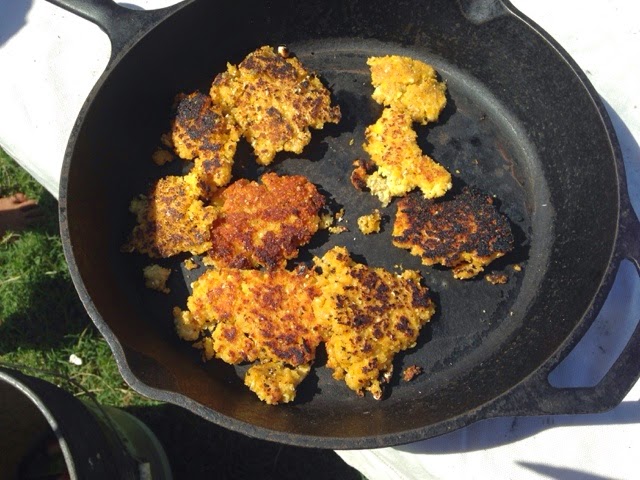
The big finale was our project day. The children dressed up in costumes that I had made for some of their older siblings. We mixed up corn cakes in honor of the Pueblo people that we had been reading about and cooked them over an open fire. We used long branches that we had pruned off our apple tree to build a teepee which we covered with an old sheet.

The children also made beaded jewelry, bow and arrows and ground acorns in a grinding stone. They ate snacks from the time period such as dried cranberries, popcorn and beef jerky.
They also presented reports, my youngest students had a report on the Pueblo people complete with a rigatoni noodle pueblo village and my 11 year old son presented his Pueblo report while donning an elaborately painted mask which he had copied from a book.
Although our project day incorporated elements from many different tribes, it was a fun filled time to experience some of what the early Americans had experienced.
After we had finished up with our project day, I handed out blank books. I purchased these in the dollar aisle at Target and we will use them as a scrapbook of our year. The children will fill in one or two pages each month with some of the information that they have learned.
We are having so much fun incorporating many elements of learning into our history studies this year! Reading interesting books to my children and exploring other cultures and time periods are just a few of many wonderful aspects of homeschooling.
This post contains affiliate links. So far, I haven't made any money from it, but it is worth a try!
4/7/14
Reading Comprehension With Winnie the Pooh
Reading comprehension could be taught with a tedious workbook and a list of questions to ask or multiple choice options, but my preference is to teach it with the use of narration. Narration is the art of telling back what you have heard. As Charlotte Mason stated,
“As knowledge is not assimilated until it is reproduced, children should ‘tell back’ after a single reading or hearing . . . A single reading is insisted on, because children have naturally great power of attention; but this force is dissipated by the re-reading of passages” (Vol. 6, preface).

In this excellent post from Simply Charlotte Mason, the simplicity and fun of narration is explained, I for one am a big fan of keeping things simple and fun, while maximizing quality literature.
Having slogged through a boring grammar workbook for most of the year, I decided that my younger children needed a break, so we started a narration series with Winnie the Pooh.

I read a chapter and then I have the children tell me what I read about. The more details the better, and narration improves with practice. This quickly lets me know how much they understood and absorbed from the story.
After the oral retelling, they spend some time writing sentences or paragraphs about what we read and drawing a picture to illustrate. I rarely get complaints from such a fun assignment, and it is nice to get a break from all the workbooks.
Even my youngest son got excited about the story, gathering his Winnie the Pooh and Eeyore to act it out. Rather unfortunately, in his quest for a realistic retelling of Eeyore's lost tale, he cut the tail off the poor, sad donkey. However, a few stitches can hopefully fix this and I do love seeing him enjoying and reliving a good story.